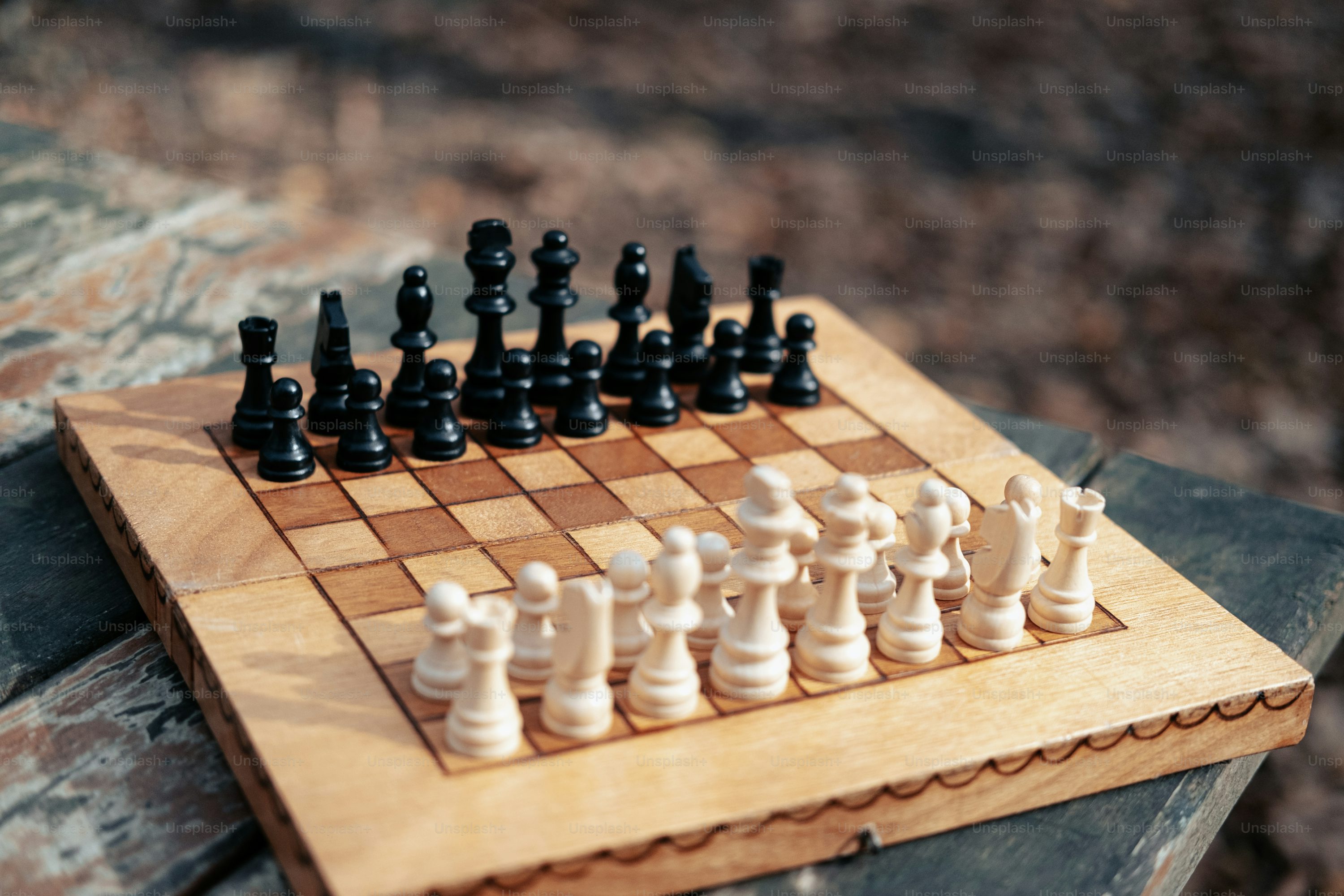
Learn about chess with this comprehensive guide covering fundamentals, practical applications, and advanced techniques.
This comprehensive guide explores chess in detail, providing actionable insights and current information to help you understand and apply key concepts effectively. Based on thorough research and analysis of the latest developments in this field, this article delivers valuable perspectives for both beginners and experienced practitioners.
Key Insights Summary
Chess is played on an 8x8 board with 6 types of pieces; the objective is to checkmate the opponent’s king by placing it under attack with no legal moves left. The game is governed by FIDE, the International Chess Federation. Practice and study are key to improvement.
The Fundamentals of Chess
Source: Best Chess Strategies – Proven Tips to Win More Games – World Chess Shop Skip to content
Best Chess Strategies – A Complete Guide to Winning Games
Best Chess Strategies – A Complete Guide to Winning Games
by Paul Chessini
·
Introduction
Best Chess Strategies are not magic tricks, they are replicable planning habits. Here you will discover how to assess any position (materials, king safety, piece activity, space, pawn structure) and translate that assessment into an action plan, and how to convert small advantages without needlessly running risks.
We will look at what strong opening play entails (quick development, control of the center, timely castling) and how your strategy should change through the middlegame to a winning endgame. […] ## For Beginners (Related Guides)
Just starting your journey? These cover fundamentals and first moves in more detail:
Chess Openings for Beginners — The best, safest opening ideas for White and Black, the opening pitfalls to watch out for, and the simple strategies you can follow as early as move one.. Chess Terminology for Beginners — A plain-English glossary (pins, forks, tempo, gambit, zugzwang) with examples so you can read guides and annotate your own games with confidence. How to Get Better at Chess — Tools, drills, and a 7-day plan.
FAQ – Best Chess Strategies
What is the best strategy in chess? […] You will see the model positions with FEN that can be loaded into analyzer and demo Gifs. so that you can study the plans graphically. We will also identify the most common strategic errors and provide clear and practical solutions—so your next game can show a smarter process, not just sharper tactics.
What Is a Chess Strategy?
In essence, chess strategy is the long range plan that gets your pieces in the right position, attacks the opponent’s weaknesses and makes your position better over a series of moves. Tactics (forks, pins, mates) are immediate opportunities which normally succeed due to a good plan making the situation favorable.
The five evaluation lenses you will reuse in this article are:
- Material
- King safety
- Piece activity
- Space
- Pawn structure.
Source: How to Play Chess: Learn the Rules & 7 Steps To Get You Started - Chess.com Chess.com
Sign Up Log In
page-article
Articles
How to Play Chess: 7 Rules To Get You Started
Learning how to play chess will be really easy with our step by step guide.
How to Play Chess: 7 Rules To Get You Started
Avatar of CHESScom
CHESScom
| 1,041 | For Beginners |
It’s never too late to learn how to play chess—the most popular game in the world! Learning the rules of chess is easy:
- Set Up The Chess Board
- Learn To Move The Pieces
- Discover The Special Rules
- Learn Who Makes The First Move
- Check Out The Rules On How To Win
- Study The Basic Strategies
- Practice Playing Lots Of Games
Here’s a video of IM Danny Rensch explaining all the rules you need to know to start playing chess.
Step 1. How To Setup The Chessboard […] 1. Play lots of chess — Just keep playing! Play as much as possible. You should learn from each game – those you win and those you lose.
- Study with chess lessons — If you really want to improve quickly then you should do some online chess lessons. You can find online chess lessons here.
- Have fun — Don’t get discouraged if you don’t win all of your games right away. Everyone loses – even world champions. As long as you continue to have fun and learn from the games you lose then you can enjoy chess forever!
Recommended Article -> 7 Tips to Get Better at Chess
What Is The Best First Move In Chess? […] Touch-move - If a player touches one of their own pieces they must move that piece as long as it is a legal move. If a player touches an opponent’s piece, they must capture that piece. A player who wishes to touch a piece only to adjust it on the board must first announce the intention, usually by saying “adjust”.
Source: [PDF] FIDE LAWS of CHESS 1 E.I.01 FIDE LAWS of CHESS Contents: PREFACE page 2 BASIC RULES OF PLAY Article 1: The nature and objectives of the game of chess page 2 Article 2: The initial position of the pieces on the chessboard page 3 Article 3: The moves of the pieces page 4 Article 4: The act of moving the pieces page 7 Article 5: The completion of the game page 8 COMPETITION RULES Article 6: The chess clock page 9 Article 7: Irregularities page 11 Article 8: The recording of the moves page 11 Article 9: The drawn game page 12 Article 10: Quickplay finish page 13 Article 11: Points page 14 Article 12: The conduct of the players page 14 Article 13: The role of the arbiter (see Preface) page 15 Article 14: FIDE page 16 Appendices: A. Rapidplay page 17 B. Blitz page 17 C. Algebraic notation page 18 D. Quickplay […] FIDE match, championship or qualifying event, or for a FIDE title or rating tournament. BASIC RULES OF PLAY Article 1: The nature and objectives of the game of chess 1.1 The game of chess is played between two opponents who move their pieces alternately on a square board called a ‘chessboard’. The player with the white pieces commences the game. A player is said to ‘have the move’, when his opponent’s move has been ‘made’. (See Article 6.7) 1.2 The objective of each player is to place the opponent’s king ‘under attack’ in such a way that the opponent has no legal move. The player who achieves this goal is said to have ‘checkmated’ the opponent’s king and to have won the game. Leaving one’s own king under attack, exposing one’s own king to attack and also ’capturing’ the opponent’s king […] B. Blitz page 17 C. Algebraic notation page 18 D. Quickplay finishes where no arbiter is present in the venue page 20 E. Rules for play with Blind and Visually Handicapped page 20 F. Chess960 rules page 22 Guidelines in case a game needs to be adjourned page 24 2 FIDE Laws of Chess cover over-the-board play. The English text is the authentic version of the Laws of Chess, which was adopted at the 79th FIDE Congress at Dresden (Germany), November 2008, coming into force on 1 July 2009. In these Laws the words ‘he’, ‘him’ and ‘his’ include ‘she’ and ‘her’. PREFACE The Laws of Chess cannot cover all possible situations that may arise during a game, nor can they regulate all administrative questions. Where cases are not precisely regulated by an Article of the Laws, it should be possible to
Detailed Explanation of Core Concepts
Understanding the core principles and foundational concepts is essential for building a strong knowledge base. This section delves into the basic definitions, historical context, and theoretical frameworks that form the basis of this field.
Key Takeaways
This comprehensive exploration of the topic provides valuable insights and practical guidance. By applying these concepts systematically, practitioners can achieve significant improvements in their work and understanding.
Best Practices and Implementation Strategies
Source: Chess Rules: Simple Guide With Illustrations And Videos This method allows players and spectators to track the game’s progress and review past games. We have a detailed guide with videos on how to read and write chess notation.
Capturing a Hostile Piece
The rules of chess have evolved significantly since the game was first invented over 1,500 years ago.
Today, chess is governed and moderated by the International Chess Federation, which sets the rules for chess games, holds chess tournaments, and maintains the Elo player rating system. The Federation is more commonly known by its French acronym, FIDE (Fédération Internationale des Échecs).
Here are the legal moves by which a chess piece can capture an opponent’s piece: […] Every square on a chessboard is represented by a column and row label. The columns are labeled with the letters “a” to “h” while the rows have the numbers 1 to 8, making the board an 8 x 8 grid. This is shown clearly in the image below.
For example, the king in the image above moves from the square “e1” to “e4.” This move would be recorded as “Ke4,” with the prefix referring to the piece that’s moving.
If it were a knight’s move, it would be recorded as “Ne4” to distinguish it from the King. Here’s a summary of the prefixes for all the six types of chess pieces.
K for King Q for Queen N for Knight R for Rook B for Bishop P for Pawn, although it’s often omitted in notation unless in a capturing move […] You get better at chess by learning and practicing the movements and strategic capabilities of each piece. Chess is revered as a strategy game that demands a high level of intellectual engagement and critical thinking. Each move requires foresight, analysis, and an understanding of the opponent’s strategy.
You must plan your moves and counter the opponent’s moves effectively, which improves tactical thinking. A good chess player analyzes, anticipates, and counters the opponent’s short-term and long-term plans.
Playing chess mentally several moves ahead is the only way to get the best of your opponent.
Kids can learn chess very quickly when given the right environment and motivation. That’s why we’re particularly supportive of chess in schools and children’s clubs.
Step-by-Step Implementation Framework
Effective implementation requires careful planning and execution. A comprehensive approach includes assessment, planning, execution, and evaluation phases to ensure success.
Key Takeaways
This comprehensive exploration of the topic provides valuable insights and practical guidance. By applying these concepts systematically, practitioners can achieve significant improvements in their work and understanding.
Advanced Concepts and Emerging Trends
Source: How to Play Chess : 14 Steps (with Pictures) - Instructables Chess is an incredibly complex strategic game, and it is impossible to go into all of the possible tactics one could use to win. However, I wanted to leave the new player with a few hints that will hopefully aid in victory.
Piece Value:
Obviously you want to protect your pieces from capture, but it helps to know which pieces are the strongest so you can decide who to save if you must choose between two. A good explanation of piece value is available on Wikipedia
Queen: Strongest = Most Value
Rook
Bishop, Knight
Pawn: Weakest = Least Value
The bishop and the knight are commonly considered equal on the value scale, however many feel (myself included) that the bishop has a slight edge over the knight.
Pawns become more valuable as they near promotion. […] Pawns become more valuable as they near promotion.
Pawn Promotion:
Although a pawn can be promoted to a variety of pieces, the strongest choice is almost always to promote to queen.
Board Control:
When building defenses, remember to look at the board and gauge how strong you are in certain areas of the board. Try an keep power distributed fairly evenly, and bring pieces over to add strength if you see an attack coming.
When attacking, it’s a bad idea to let any of your pieces become cut off from your main force. I find it helpful to have a support piece in mind when making an attack. Using pieces in tandem almost always yields a better result than using one piece alone.
Cutting-Edge Developments and Future Directions
Once the basics are mastered, exploring advanced methodologies deepens expertise. Emerging trends are reshaping how we understand and apply these concepts across multiple domains.
Key Takeaways
This comprehensive exploration of the topic provides valuable insights and practical guidance. By applying these concepts systematically, practitioners can achieve significant improvements in their work and understanding.
Case Studies and Real-World Examples
Examining real-world applications provides valuable insights into how chess works in practice. This section presents detailed case studies that demonstrate successful implementation and lessons learned.
Each case study illustrates specific challenges, the approach taken to address them using chess principles, and the measurable outcomes achieved. By studying these examples, practitioners can gain practical understanding and avoid common mistakes.
Conclusion
In summary, chess represents a significant area of study with far-reaching implications across multiple domains. By understanding the fundamental principles, practical applications, and advanced concepts discussed throughout this comprehensive guide, you’re now equipped to make informed decisions and contribute meaningfully to discussions about chess. The rapidly evolving nature of this field means continued learning and adaptation will be essential for staying current and effective in related endeavors.
Additional Resources
For more information on chess, consult reputable sources and stay updated with the latest developments in this evolving field.